
CYCLE 1 · ENGLISH · FOUR WEEKS
How your child’s four-week course can work
A fixed lesson.
Support for the
week around it.
One four-week fee.
Support beyond the lesson.
One-to-one English and Chinese tutoring and academic coaching for GCSE and IB students.
Your child’s course includes regular teaching with Grades & Growth, personalised practice, detailed feedback and guidance between lessons. Their questions, written work and progress help us decide what to teach next.
When more direct guidance would help, additional lessons we agree to arrange are included in the same four-week fee. Your child can ask for help with a difficult text, an unclear essay or a demanding school week without worrying about another tuition charge.

A small number of students.
Time to respond.
For 2026/27, Grades & Growth will enrol just 6–8 students. Keeping enrolment small gives us time to prepare individual lessons, review written work and arrange additional guidance.
Extra sessions are usually arranged on Wednesdays or Thursdays, according to the student’s needs and availability. If a task would benefit from discussion, your child can request a lesson to work through it. Agreed additional lessons are included in the course fee.
Teaching develops the skills. Coaching helps students use them.
A student may understand an essay question and still struggle to begin. A disappointing mark may make them reluctant to try again. A busy week may leave them unsure which task needs attention first.
Grades & Growth helps students organise their ideas, break demanding work into manageable steps and decide what to do next. When confidence or energy drops, we adapt the work and return to academic content that needs further attention.
Students practise asking for help, responding to feedback and making their own decisions. Over time, the aim is for them to approach their work with greater confidence and less guidance.
Their work shapes the next lesson.
Grades & Growth reviews classwork, homework and questions to identify what the student understands and where further teaching would help. Follow-up exercises address those specific difficulties, and the next lesson builds on what their work reveals.
Parents receive progress updates at least once a fortnight, with opportunities to discuss concerns and agree on next steps.
What this can look like over four weeks
Alex’s English course is an illustrative example. The teaching and additional support would be adapted to each student.
-
Alex has ideas about a character but struggles to explain the evidence. The tutor teaches the skill, reviews Alex’s paragraph and prepares practice around the difficulty.
-
A Geography essay needs a clearer argument. In an agreed additional session, Alex practises interpreting the question, selecting evidence and explaining a judgement. The session is included in the course fee.
-
Alex feels discouraged and struggles to begin. The tutor listens, reduces the task to a manageable size and helps Alex organise a paragraph. Academic work needing more attention is revisited.
-
Alex asks for help with an approaching deadline. Grades & Growth’s tutor is available and agrees to an additional session, included in the fee. Together, they clarify the question and improve the plan; Alex completes the writing independently. Weekend sessions are exceptional and depend on availability.




Before the first Monday
-
Friday 4 September
Payment is due ten days before this example cycle begins. The payment deadline does not determine statutory cancellation dates.
-
Thursday 10 September · 09:00
Alex and a parent receive the four-week PDF pack by email. They print it as supplied and keep it in a folder.
-
Every week
Thursday PDFs respond to submitted work and discussion. Handwritten homework goes by email before Sunday at 18:00, even if unfinished.
WEEK 01 / 14–20 September
01
Finding a voice in literature
Alex has plenty to say about fairness, but finds it harder to explain how a writer creates meaning. The first week starts with those ideas.
MON · 16:00–18:00
The fixed English lesson
Read a selected Act One extract together. Explore how Torvald addresses Nora, then examine dialogue, stage directions and power. Alex chooses evidence and writes a paragraph by hand, with time for discussion and feedback.
THU · 09:00
Practice built from the lesson
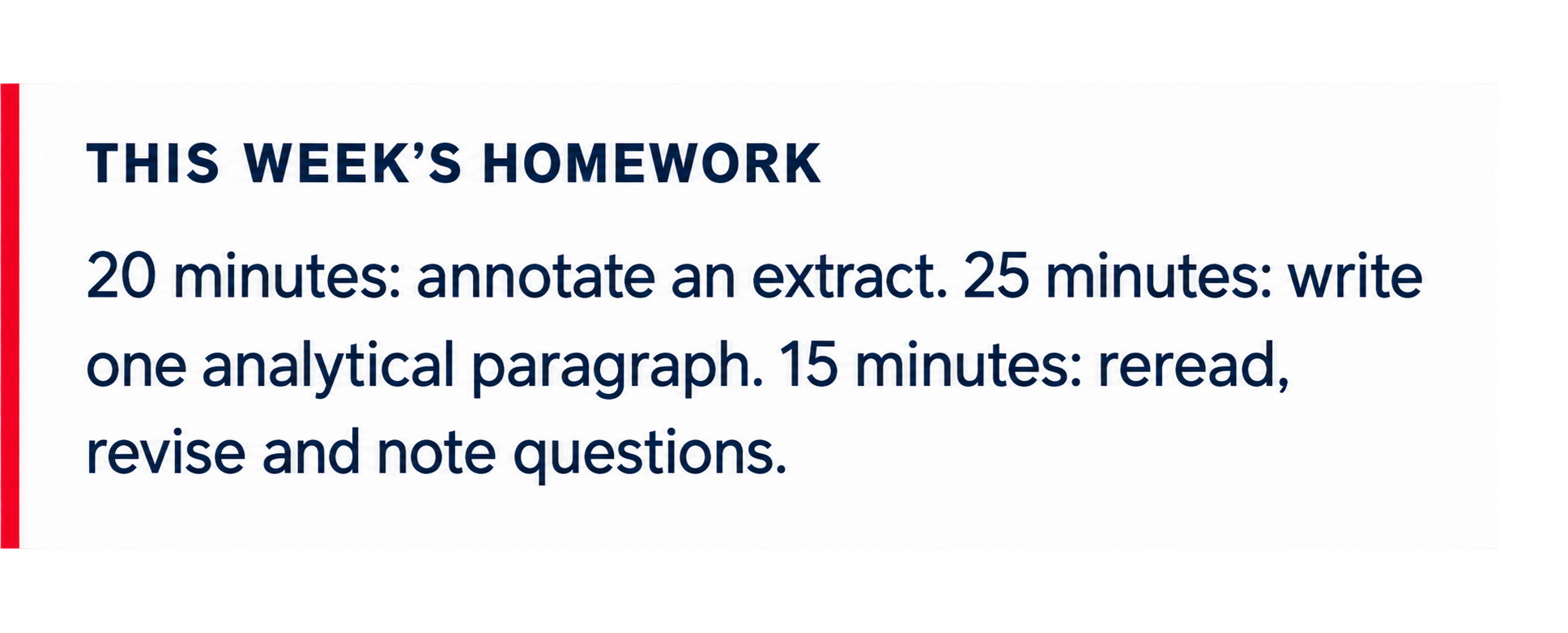
A PDF arrives for Alex and a parent: a vocabulary exercise on power and independence, an annotated paragraph and practice explaining the effect of a short quotation.
SUN · BEFORE 18:00
Submit an attempt, including questions
Alex emails photographs of the handwritten work at 17:20, including one unfinished explanation. Miss Ellie uses it to prepare the next Monday lesson.

-
How does Ibsen present power in Nora and Torvald’s relationship in this extract?
Dialogue · stage directions · evidence · explanation
WEEK 02 / 21–27 September
02
Taking essay skills into Geography
A school Geography task asks Alex to evaluate transport choices. The subject changes; selecting evidence and explaining a judgement remain useful skills.
MON · 16:00–18:00
Feedback, then a stronger argument
Review Week 1’s writing. Return to the play to distinguish a claim about Nora from evidence that supports it. Practise linking an observation about language to an interpretation.
THU · 09:00 + 16:00–17:00
Materials, then Geography support
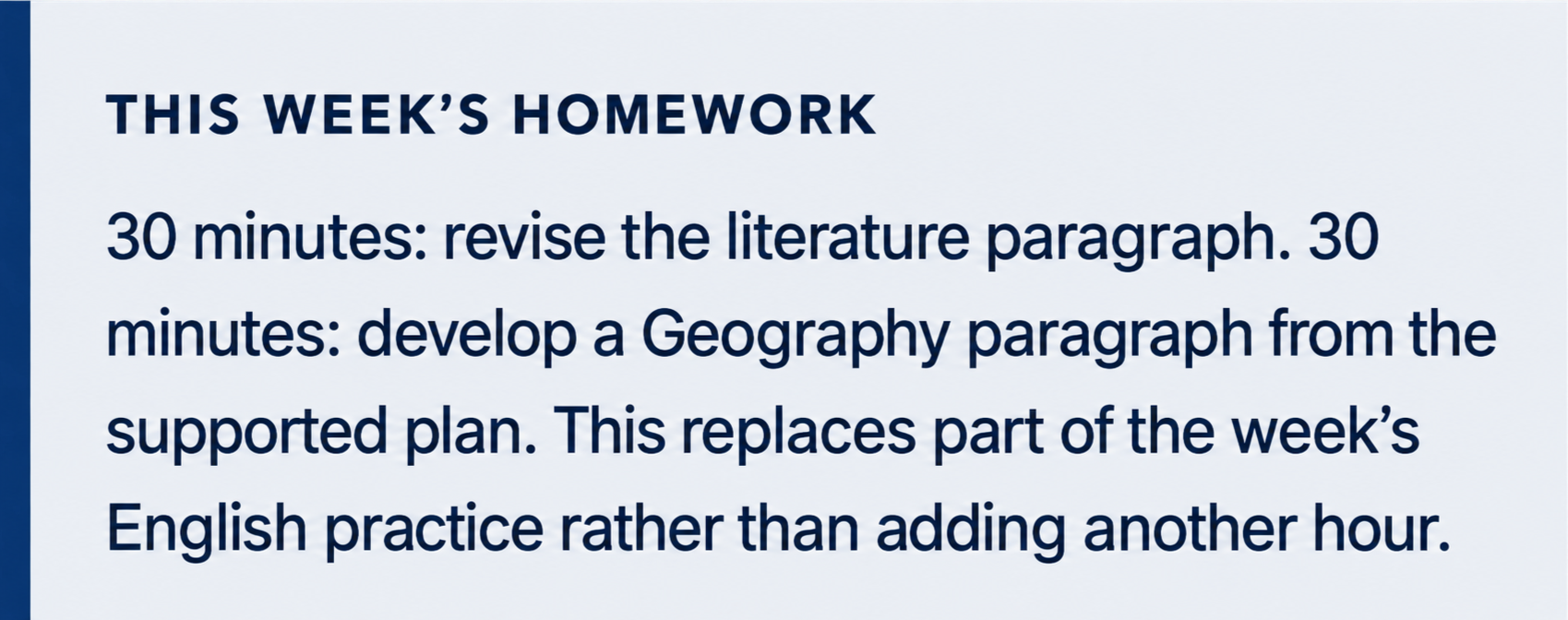
After emailing the question, deadline, school notes and an attempted plan, Alex has an agreed one-hour session. Using the school’s case study, discuss sustainable urban transport: benefits, limitations and a reasoned judgement. A parent is informed of the booking.
SUN · BEFORE 18:00
A handwritten response
At 17:30, Alex emails a revised literature paragraph and a Geography practice paragraph. School-assignment review follows the school’s rules; Alex writes the final submission independently.

-
Evaluate how transport strategies can help make an urban area more sustainable. Use evidence from your school’s case study.
Non-fiction writing · cause and effect · evaluation
WEEK 03 / 28 September-4 October
03
A difficult week. Time to talk.
A friendship difficulty and a disappointing school mark leave Alex upset and reluctant to write. Miss Ellie makes room to listen without asking Alex to share more than feels comfortable.
MON · 16:00–18:00
An adapted regular lesson
Coaching takes more of the session. Together, they identify one manageable task and briefly explore how a character’s outward behaviour can differ from their feelings. Planned academic work is reduced and revisited later.
WED · 16:00–16:45
An agreed session to regain confidence
Alex requests help and a parent is informed. In 45 minutes, they talk through what feels difficult, organise three ideas and begin a paragraph together. Rest comes before further demanding work.
THU · 09:00 / SUN · BEFORE 18:00
A smaller task, with support
Thursday’s PDF contains a shorter follow-up. At 17:00 on Sunday, Alex sends one revised paragraph and a question. A parent receives an update focused on patience and support, with private details respected.

-
Choose one moment where Nora’s words or behaviour suggest a feeling she does not openly express. Explain your interpretation.
Confidence · manageable steps · independent expression
WEEK 04 / 5–11 October
04
A forgotten deadline. A practical next step.
On Sunday, Alex remembers that a school literature response is due on Monday. The task is started, but the argument is unclear. Alex takes responsibility and asks for focused help.
MON · 16:00–18:00
Bring the reading together
Compare Nora’s presentation across selected scenes, including the final conversation. Review paragraph structure and practise planning a response with a clear line of argument.
THU · 09:00
Feedback and a clear plan for further practice
Alex receives individual feedback, a short revision task and a planning checklist. The ordinary homework submission remains available before Sunday at 18:00.
SUN · 16:10 → 16:35–16:55
A 20-minute lesson, arranged at short notice
Alex sends the deadline, instructions, draft and two questions by WhatsApp. Miss Ellie happens to be available and confirms a call starting 25 minutes later. They clarify the question and improve the plan; Alex completes the writing independently. A parent is informed.
-
How does Ibsen present Nora’s changing understanding of herself? Select evidence before deciding the order of your argument.
Prioritising · asking for help · planning · ownership
WHAT SETS GRADES & GROWTH APART